I'd fried my HV main feedthrough on a really brutal run to activate some new things the other day, and it got so bad I couldn't use it to test the new hornyak detectors, so time to go ahead and break vacuum (I leave the main one on the pump 24/7 normally) and fix and improve some things. Since this also documents some construction details I've been asked about but was too lazy to take it far enough apart to get pix of, well, here they are since it was easy to do this time.
I've been asked "how do you handle the HV around a fusor. "Very carefully" is the trite answer, but also true. I try to keep the stray capacity down, and mount the ballasts right on the feedthrough, blow in cooling air, and shield the entire mess as though I was making a big piece of coax with the ballast as the center conductor. This cuts down ozone, which is minor, and EMI with is anything but. Don't forget that a near perfect 30-50pf capacitor (all the strays) at 50kv can discharge in nanosecond timeframes, providing kiloamps of current - at kilovolts, that's millions of peak watts of RF in the shack - not good for everything else, and before I got more careful, has fried PC computers at 10 feet that weren't connected to this in any way. Serious EMI indeed.
Now it's so quiet it's hard to pick up on a scope probe. But here's what's under all the shielding and cooling:
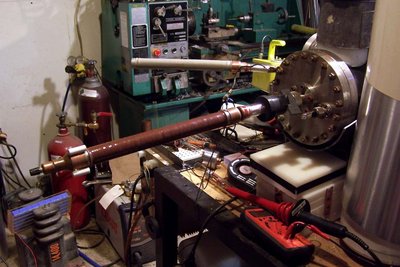
- All the gunk stripped off. Resistors are 225w wirewound, the main one is 50k, the aux one is 100k.
As luck would have it, these fit nicely into fitting for 1" copper pipe, so I use those for mounting and connecting. The ends of the FT's are threaded 10-32 to accomodate this plan, and the HV supplies have banana plugs on the ends of their coax, which just happen to fit nicely into a jack for the main one, or just another 10-32 hole in the secondary one in the background in the above pic.
While I was waiting for the air to get into the tank through the slow bleed valve, I made a shield for the #2 grid (ion generator). Since sched 40 pvc won't quite stand off the 40kv max that one can see (it's usually run closer to 10kv, but "stuff happens"), I made a teflon sheet wrap for the otherwise uninsulated resistor while I was at it. I don't care if that tape melts - it just lets me fit it into the pvc without trouble when putting it together.
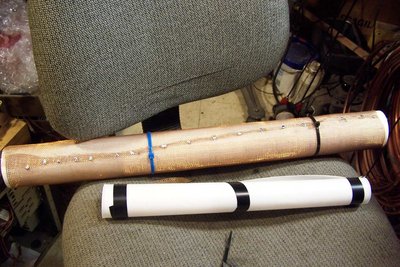
- Shield for the aux grid HV feedin
The proximate reason to tear this down was some arcing in the main feed through. I'd run it brutally (53 kv, 30 ma, 20 minutes) awhile back, and that toasted it - even my big grid got orange hot in the middle of the rods for a long time in that one, and I almost got the end red hot. I'm using pyrex and quartz for the insulators, either of which can be reduced to its component metals by hot H - and this stuff is as hot as it gets...When I put this together, I'm trying another scheme to protect this. Here's what the damage looks like:
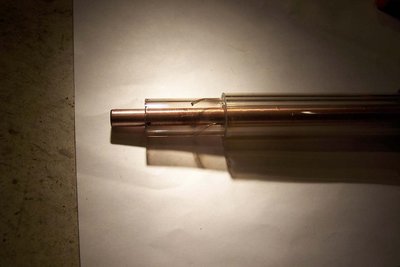
- Note cracks in the quartz...
I had a mirror under this so I could watch it fail (this has been an ongoing issue). What's interesting is that while I could see arcing, it was fully contained in the quartz, right about where the pyrex outer tube ends. No spark out to the tank, and no spark into the center conductor either - just inside the quartz. I'd presume that it picked up enough charge on opposite sides of the thickness to just arc through, and the damage was done by energy stored in the capacity of the quartz, but that's a guess. Since more or less nothing can really stand this gaff - zillion degree pre-ionized deuterium hitting it, I decided to simply put a grounded pipe around the entire mess and let it take any hits - but since it's grounded, it doesn't attract ions. This seems to work, using the paradoxical Paschen's law in my favor -- the distance between the end of the grounded pipe and the grid end is too short for a discharge to occur there! Doesn't satisfy p x d

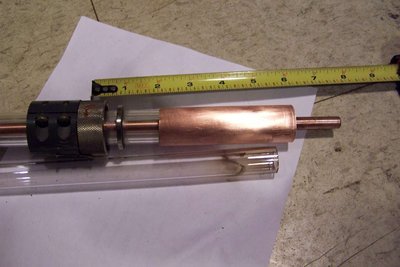
- New one with pipe about where it will be.
The copper pipe won't go into the coupler, but it does fit inside the flange hole for the 2.75" CF, and to get it grounded, I just shoved in a little bit of that handy copper screen wire, bent to contract the hole and the pipe. Here's what it looks like installed:
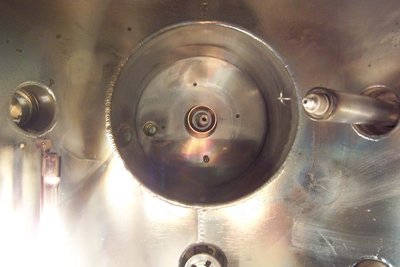
- End view, before the grid is added. It's off center now, but when I hang on the ballast, it centers.
The copper pipe sticks into the tank about 3/4" more than the insulators do, so they don't get hammered so hard by stray ions - in tests after I did this, the crazy idea actually seems to work quite well.
I'm running out of pix I can attach to a single post, so I'll reply with more -- and some movies of it in action I'll post somewhere, and at least link to from here - I got some amazing results during the break in running that really surprised me, and which deserve close attention and documentation (maybe I should put them into run data).
Posting as just me, not as the forum owner. Everything I say is "in my opinion" and YMMV -- which should go for everyone without saying.
